30 by 30: How the High Seas Treaty Made Ocean Protection Real
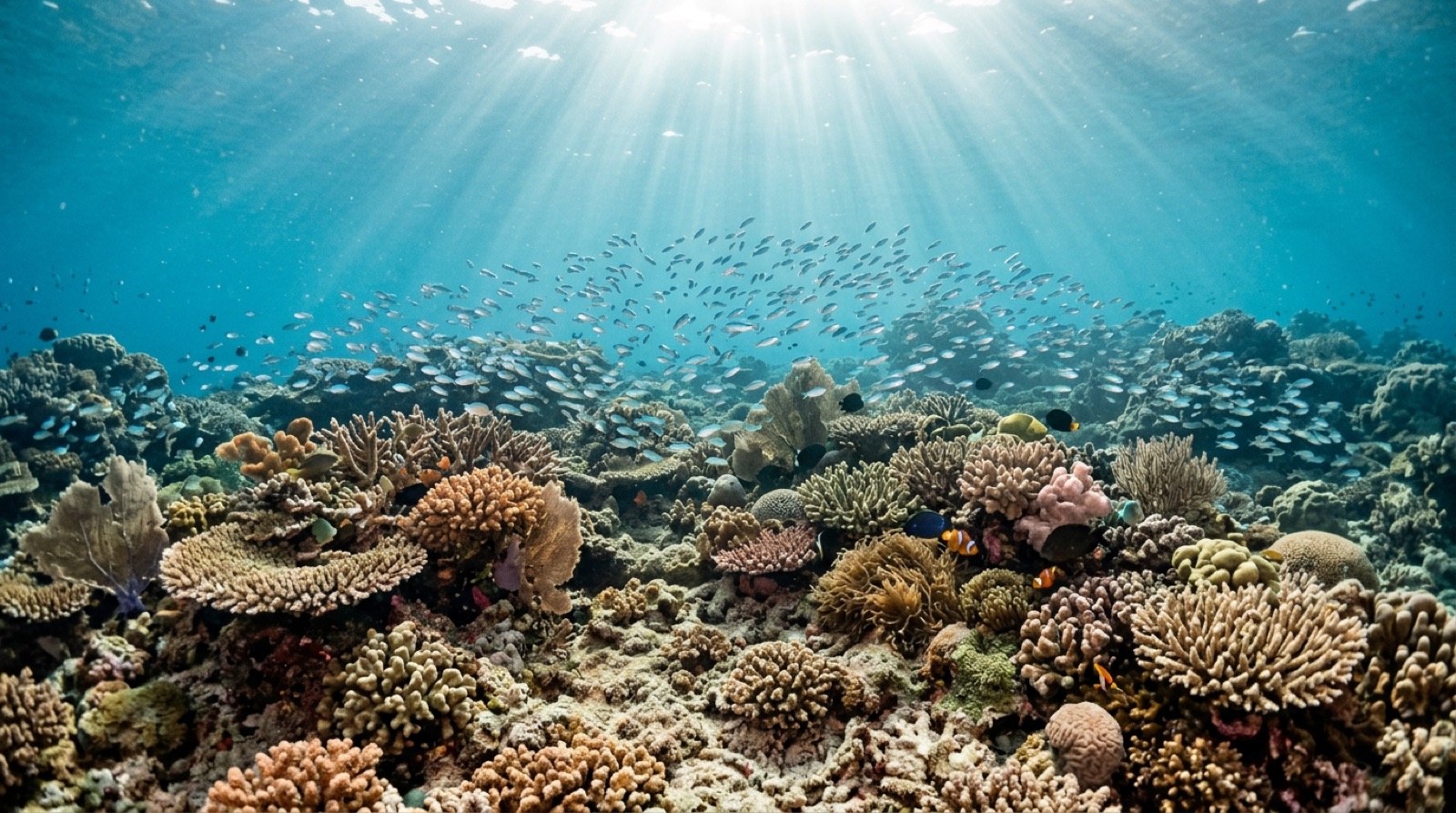
Sixty percent of the ocean belongs to no country. Until 2023, that was a legal vacuum: no fishing rules, no biodiversity protection, no enforceable limits at all. The High Seas Treaty changed that, and 2025 was the year it started becoming real. Here is what actually happened, what is still missing, and what each of us can do.
First, the headline: 30 by 30
In December 2022, almost every country on Earth signed the Kunming-Montreal Global Biodiversity Framework. It commits the world to protecting 30% of land and 30% of ocean by 2030. That is a step change: as of early 2024, only about 8% of the ocean was inside a marine protected area (MPA), and less than 3% was strictly protected from extraction.
30 by 30 is the most ambitious ocean target in history. Hitting it means roughly tripling protected ocean area in five years, while making sure those new MPAs actually do something.
The piece nobody had: a treaty for the high seas
Before 2023, every coastal country could regulate the 200 nautical miles of ocean off its coast. But the high seas — the 60% of the ocean beyond any country’s control — had no biodiversity law. You could trawl, mine, dump, or fish almost anywhere with no real oversight.
The UN Agreement on Marine Biodiversity of Areas Beyond National Jurisdiction (BBNJ) — better known as the High Seas Treaty — closes that gap. Adopted in June 2023, it lets countries jointly:
- Establish marine protected areas in the high seas for the first time.
- Require environmental impact assessments for industrial activities in international waters.
- Share the benefits of marine genetic resources equitably between rich and developing countries.
- Build the capacity in lower-income countries to actually enforce ocean rules.
“The treaty is the most important multilateral environmental agreement signed since the Paris Agreement.”
— Rena Lee, UN BBNJ conference president, 2023
The treaty needs 60 ratifications to enter into force. Through 2024 and 2025, ratifications climbed steadily — the EU, Mexico, Chile, Palau and others moved early. The treaty is widely expected to enter force during 2026, which is the moment the legal machinery actually turns on.
What 2024 and 2025 actually delivered
Three concrete things moved in the right direction:
- The EU Nature Restoration Law entered force in August 2024. It legally requires member states to restore degraded marine ecosystems — including seagrass, oyster beds and reefs — on a binding timeline. European Commission.
- Several large new MPAs were declared, including expansions of the Galápagos Marine Reserve, new no-take zones in Australia and the UK Overseas Territories, and Pacific Island commitments under the “Big Ocean States” framework.
- Bottom trawling restrictions finally got political traction. Multiple EU member states proposed phasing bottom trawling out of MPAs by 2030, and the OSPAR Commission tightened rules for the Northeast Atlantic.
Why bottom trawling matters for climate
Most people don’t realise the ocean floor is one of the largest carbon sinks on the planet. A 2021 study in Nature estimated bottom trawling releases roughly 0.6 to 1.5 billion tonnes of CO2 per year from disturbed sediment — comparable to the entire global aviation sector. Sala et al., Nature 2021.
Phasing bottom trawling out of MPAs is therefore both an ocean-protection move and a climate move. Two problems, one fix.
The honest part: most MPAs are still paper parks
Here is the part you don’t hear in press releases. MPAtlas, which tracks every marine protected area in the world, finds that only about one third of the ocean area officially designated as “protected” actually has fishing or extraction restrictions. The rest is what scientists politely call “paper parks” — designated on a map, but with no real change on the water.
30 by 30 cannot become a number on a wall. To deliver real ocean recovery it has to mean:
- At least one third of the protected area is highly or fully protected from fishing — the level the science consistently shows is needed for biodiversity to rebound.
- Enforcement is funded — satellite monitoring, on-water patrols, and the international cooperation BBNJ now enables.
- Coastal communities are involved early, because protection only sticks when local economies have a place in it.
None of that is automatic. It is a choice each country makes year by year.
What you can actually do
Ocean policy can feel distant. It isn’t.
1. Choose differently at the fish counter
- Use a science-backed seafood guide. The Monterey Bay Aquarium Seafood Watch, the Marine Conservation Society Good Fish Guide (UK) and the MSC blue label are the most reliable starting points.
- Two practical rules of thumb: eat lower on the food chain (sardines, mussels, mackerel) and avoid bottom-trawled species (most cod, hake, prawns) unless they are clearly line- or pot-caught.
2. Use your political voice
- If your country has not yet ratified the High Seas Treaty, write to your MP / senator / MEP. Ratifications are the unlock.
- Support organisations doing the on-water work: Oceana, Marine Conservation Institute, IUCN Oceans, Surfrider.
3. Cut what reaches the ocean in the first place
- About 80% of marine pollution starts on land. The two biggest leverage points for households are plastic (refuse single-use, support deposit-return schemes) and fertiliser runoff (low-input gardening / supporting agricultural reform that reduces dead zones).
For the next generation
The ocean is our planet’s biggest climate stabiliser. It has absorbed about 30% of all the CO2 humans have emitted, and over 90% of the extra heat trapped by greenhouse gases. It is also the single biggest source of biodiversity, oxygen and protein on Earth.
For most of human history, the ocean was treated as too big to break and too distant to govern. 2025 is the year that finally started to change. Whether 30 by 30 becomes real recovery or just a slogan depends on what every government — and every household — does between now and 2030.
Sources & further reading
- UN — Agreement on Marine Biodiversity of Areas Beyond National Jurisdiction (BBNJ)
- UN — Kunming-Montreal Global Biodiversity Framework (30 by 30)
- MPAtlas — Real-time tracking of marine protected areas
- Sala et al., 2021 — Protecting the global ocean for biodiversity, food and climate (Nature)
- IUCN — Oceans programme
- Oceana — Reports library
- European Commission — Nature Restoration Law
This is post #2 of ClimateClue. Next: industry — can “hard-to-abate” sectors actually decarbonise?